
SUI Crypto Network Makes Quantum Computing Breakthrough: Shuns Bitcoin, Ethereum

Key Insights:
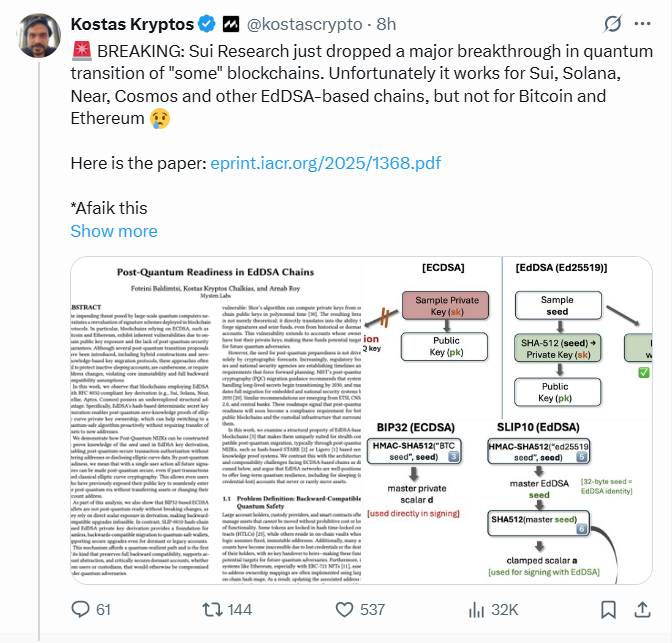
- Sui crypto Network, in collaboration with Mysten Labs and George Mason University, has introduced a quantum upgrade path for specific blockchains.
- Bitcoin and Ethereum utilize an ECDSA algorithm that lacks a reusable cryptographic witness for quantum-safe upgrades.
- Solana developed the Winternitz Vault to address concerns related to quantum computing.
In collaboration with Mysten Labs and George Mason University, the Sui crypto Network has introduced a quantum upgrade path for specific blockchains.
Precisely, this service is only available to EdDSA-based blockchains, such as Sui, Solana, Near, and Cosmos. Shockingly, it excludes Bitcoin and Ethereum.
Notably, the recent development could revolutionize the future of blockchain security.
Is Quantum Computing Capable of Breaking Cryptography?
News of the quantum transition innovation was broken on X by top cryptographer and ethical hacker Kostas Kryptos Chalkias.
As a result of this development, Sui crypto and other EdDSA chains, such as Solana and Near, are positioned as pioneers in the post-quantum era.
On the other hand, Bitcoin and Ethereum strongly rely on the ECDSA algorithm, which is primarily perceived as being vulnerable to quantum threats.
Also, ECDSA algorithms lack a reusable cryptographic witness for quantum-safe upgrades. Unfortunately, this leaves both Bitcoin and Ethereum networks crawling to enter the post-quantum era.
Generally, there is a growing awareness about the potential threats associated with the rise of quantum computing, particularly in the field of cryptography.
However, some key players in the crypto industry have shared their thoughts on the hope that quantum computing is not yet capable of breaking cryptography in its current state.
In December 2024, Ki Young Ju, founder of CryptoQuant, took to X to assure his followers that quantum computers cannot break Bitcoin.
This was in agreement with an earlier post from Blockstream CEO Adam Back.
Even Kostas Kryptos noted on X that he has doubts about whether the tech industry has achieved quantum supremacy that can soon render cryptography obsolete.
Google Willow’s Quantum Computing Pose Threat For Cryptography
However, innovations like Google Willow have sparked growing concerns about the possibility.
Willow is a new quantum computing chip from Google. It’s touted as being capable of outperforming existing supercomputers in transaction processing capabilities.
It would take five minutes to perform complex computational tasks that classical supercomputers will need 10 septillion years to accomplish.
On the flip side, it makes passwords and encrypted messages vulnerable to breaches. Such messages could be intercepted, while nuclear weapon codes may become easily accessible.
At this rate, blockchain networks may no longer be as safe as projected. Funds, even from Satoshi Nakamoto’s wallet, could be drained in milliseconds, leaving investors with massive losses.
Kostas Kryptos believes that the first victims, for when quantum computing eventually becomes strong enough, would be lost keys, wallets of deceased persons and those funds in cold storage.
On this premise, security agencies have recommended that all algorithms undergo an upgrade by 2035. With the introduction of the Sui crypto Network transition, EdDSA-based blockchains are at an advantage.
Solana Introduces Quantum-Resistant Vault Against Quantum Computing
Meanwhile, Solana has also made an effort to keep blockchain users safe from emerging threats posed by quantum computing.
It pushed out the Winternitz Vault, which is allegedly designed to safeguard funds from future quantum threats. This Vault utilizes Winternitz One-Time Signatures (WOTS) to achieve this feat.
This Winternitz Vault feature is designed to tackle a critical blockchain vulnerability. The singular process of signing transactions could expose users’ public keys.
With the vault, there is reduced risk of compromise as it generates new cryptographic keys for every transaction.
Users are not mandated to upgrade their network before they can opt in for quantum-resistant security of their funds.
In response to the threat posed by quantum computing, Solana’s Winternitz vault generates as many as 32 private scalars, hashes each one 256 times. It stores only the final hash as the public key.
Once a transaction is completed, the vault closes and generates a new set of keys. This way, it is almost impossible for an attacker to crack and compromise previously exposed keys.
The post SUI Crypto Network Makes Quantum Computing Breakthrough: Shuns Bitcoin, Ethereum appeared first on The Coin Republic.